
SHV has developed a robust approach to risk assessment and mitigation over recent years. Key business risks are regularly reviewed at both SHV and Group level to ensure they stay relevant in the face of ever-changing operating environments. We also continually optimize all related controls to monitor and manage specific risks as effectively as possible. The Groups are provided with clear guidance to maintain a consistent performance.
This chapter outlines our overall risk management framework, the key risks we face, and how we manage them on a day-to-day basis.
All Groups and their respective business units conduct comprehensive risk assessments using common rating and reporting criteria based on the SHV Risk Assessment Approach. The aim is to build a clear overview of key risks in terms of likelihood, impact, acceptance, and ability to mitigate. This in turn provides the basis for discussion at planning and strategy meetings, as well as a benchmark for the effectiveness of internal controls.
SHV Policies and Guidelines provide the Groups with clear direction on the standards expected from all colleagues. They not only support employees in conducting business better but also guide us on the journey to becoming an ever more self-evaluating and faster learning organization.
The Business Support Framework (BSF) equips Groups with the key controls they need to monitor their performance in line with the SHV Policies and Guidelines. These controls are assessed throughout the year by the Groups themselves, as well as by internal control departments. Each Group is also required to reinforce this approach with business-specific key controls, which are evaluated against the latest key risks on an annual basis.
The Delivery & Development Agenda measures and monitors the execution of strategy, classifying key strategic elements into concrete topics. Delivery Agenda topics relate to execution-ready initiatives, whereas the Development Agenda focuses on areas that require further exploration before moving to the execution phase. This structured approach provides a solid framework for the analysis of current performance, as well as ongoing business developments.
A range of other programs also support the Groups in addressing key risks and strengthening the second-line monitoring of processes and control activities. In addition to the Ethics & Compliance framework, these initiatives include the SHV Information Security Program (SISP), SHV Health & Safety Policy, Minimum Global Standards for Project Management as well as the Minimum Global Standards for Strategy & Architecture to name just a few.
As part of the annual risk management cycle, the Executive Board of Directors (EBD) and the SHV Functional Directors conducted a company-wide risk assessment over the course of 2025. The assessment set out to identify key risk areas, validate the effectiveness of internal control measures, and identify any actions required to mitigate risk within SHV parameters.
The results confirmed the company’s risk appetite as strategically high with a relatively moderate attitude towards operational and financial risks. SHV remains steadfastly committed to Health & Safety, quality, fraud prevention and compliance.
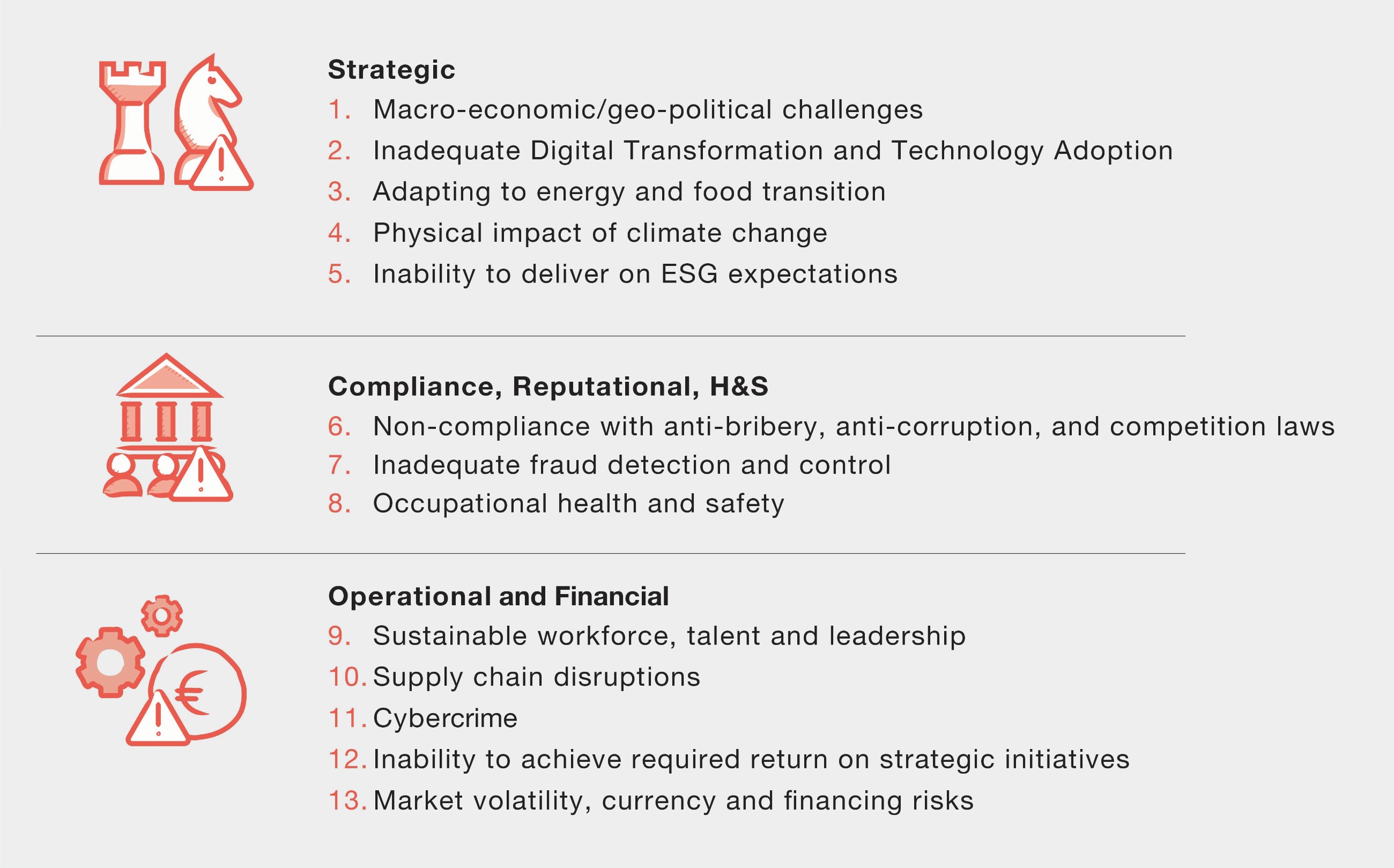
This risk assessment was aligned with our Double Materiality Assessment, a cornerstone of Corporate Sustainability Reporting Directive (CSRD) compliant ESG reporting. By taking an outside-in perspective, which analyzes the impact of sustainability aspects on business performance, the risk assessment identified the key risks our organization currently faces.
Strategic risks
Risk description | How the risk is managed |
|---|---|
SHV operates in 72 countries with varying degrees of political, legal, and fiscal stability. This exposes us to a wide range of global and regional risks. Regional conflicts, unstable regimes and inflationary pressure may hamper our global objectives, and potential armed conflicts may put our people’s safety in danger besides negatively affecting our business resilience. The growing tension due to regional conflicts increases the prices of multiple commodities, leading to disruptions in our supply chain. Furthermore, the measures introduced by several countries to secure their economies can potentially increase our costs, which may in turn negatively impact SHV's income from operations. Recent geopolitical shifts, driven by economic nationalism and rising protectionism, are also reshaping the risk landscape for global IT operations. This could trigger increasing digital sovereignty demands. | SHV and its Groups focus on the disciplined execution of strategic initiatives and the strengthening of market positions, together with an unwavering focus on controlling costs, managing working capital, and improving margins. By operating in multiple regions, we can mitigate the impact of localized disruptions and leverage opportunities in more stable or growing markets. Our local businesses provide valuable insights into local market dynamics, enabling us to adapt swiftly to changes in the macro-economic and geo-political landscape. This strategic diversification enhances our resilience and positions us to capitalize on global opportunities, supporting sustainable growth. To address emerging challenges such as digital sovereignty and reliance on global technology vendors, SHV analyzes risk scenarios and defines response strategies to support business resilience in a rapidly evolving geopolitical environment. SHV and its Groups are establishing Strategy & Architecture (S&A) practices and central S&A repositories, alongside the adoption of S&A Minimum Global Standards. These initiatives will generate up‑to‑date perspectives of the technology landscape — illustrating the interrelation of capabilities, processes, data, organization, systems (vendors) and dependencies. This will enhance business continuity planning and accelerate incident response, while reducing complexity and limiting vendor sprawl, making it easier to identify vendor‑related exposure. Economic factors and geopolitical developments will continue to influence our operations. SHV continuously monitors all developments and societal issues relevant to its interests. SHV and the Groups are committed to conducting business with integrity and operating in compliance with all applicable laws and regulations, guided by our Ethics & Compliance program and SHV Tax Policies. |
Risk description | How the risk is managed |
|---|---|
To remain competitive and future-ready, SHV and its Groups should continue to modernize the IT landscape to enable scalable, secure, and integrated digital and data capabilities. Failure to keep pace with technological evolution may lead to fragmented systems, reduced innovation capacity, and an inability to respond effectively to dynamic market and operational demands. Furthermore, the unsuccessful implementation of technology programs can result in financial losses, failure to realize anticipated benefits, and misalignment with the organization’s strategic objectives | Adapting to digital transformation by leveraging technology is critical for long-term resilience, operational efficiency, and sustained competitiveness. Rapid advancements in artificial intelligence and other disruptive technologies are reshaping business models, decision-making frameworks, and workforce expectations. These developments present both significant opportunities and complex challenges that require timely, strategic, and coordinated responses. Agility remains a core element of the SHV Purpose, anchored in our People. We invest in comprehensive training and leadership development, enabling our workforce to build leadership qualities, adapt to change, and make decisions quickly. Together with the Groups, SHV cultivates an innovation-centric culture to drive organizational agility. Over the years, innovation has become an inherent part of the strategic agendas across the entire SHV Family of Companies. Data remains pivotal to the value proposition and the performance of all Business Units, strongly influencing Investments, Sales and Operations Planning (S&OP), and working capital. To support decision-making and meet increased reporting requirements, SHV and the Groups prioritize data-driven risk insights and process automation through initiatives such as Pulse – the SHV Data Strategy Program led by Adaptfy, our integrated Data & Analytics (D&A) organization. To accelerate digital transformation and technology adoption, SHV has released the Strategy & Architecture (S&A) Minimum Global Standards across its group companies. This familiarizes Group companies with a proven, repeatable S&A methodology to translate strategy to transformation, supporting the delivery of roadmaps, governance artefacts and training to speed adoption, align business and IT, enhance innovation, improve scalability and reduce time-to-market. We will further create and facilitate a collaborative Community of Practice (CoP) for the Groups to share designs, run targeted assurance, provide training and coaching regarding architecture decisions and metrics. As a service to the Groups, our development agenda includes a digital strategy framework and a technology watch tower within the S&A practice. This will continuously provide a means to look forward and identify technology trends and define how these trends can be incorporated into digital/technology strategy, customer journeys, and the overall digital / technology estate. SHV head office and the Groups also collaborate on the Better Together program, which aims to standardize IT services and establish a foundation for the digital initiatives that will underpin business resilience, effectiveness, and efficiency. |
Risk description | How the risk is managed |
|---|---|
Driven by evolving consumer preferences, a failure to adapt to the energy and food transitions may structurally impact our business models and result in market share decline and loss of customer trust. | SHV and its Groups actively address the challenges of energy and food transition through strategic investments, focused innovation, and the implementation of sustainability initiatives across operations, supply chains, and product offerings. At Group level, SHV Energy is accelerating the energy transition by expanding renewable energy solutions, such as bio-LPG and other low-carbon fuels, while modernising infrastructure to support cleaner and more efficient energy distribution. Nutreco is driving the food transition by developing sustainable feed solutions, reducing environmental impact, and supporting animal health and productivity under evolving environmental and market conditions. These efforts are complemented by SHV-wide programs focused on embedding sustainability into business models, ensuring alignment with shifting consumer expectations, and meeting increasingly stringent regulatory expectations. Continuous monitoring of market trends, stakeholder expectations, and geopolitical developments enables timely adaptation, while cross-Group collaboration fosters innovation, capability building, and knowledge sharing. These combined initiatives aim to maintain competitiveness, protect market share, and strengthen long-term customer trust in an increasingly dynamic global landscape. |
More frequent and severe weather events may threaten the organization's assets and future cash flow due to the increasing cost of revamping Business Continuity plans to avoid disruption, maintain the provision of essential products and services, or recover operating costs. The physical impact of climate change also threatens our operations by disrupting the availability and cost of key raw materials. At the same time, heat stress and altered growing conditions impair animal health and productivity. | SHV and its Groups address the physical impacts of climate change through a combination of resilience planning, sustainability initiatives, and regulatory alignment. At Group level, business continuity strategies are regularly updated to account for extreme weather scenarios, ensuring operational readiness and safeguarding supply chains. As part of ongoing Corporate Sustainability Reporting Directive (CSRD) preparations, SHV is advancing its climate adaptation and mitigation efforts by embedding climate-related risk management into governance and reporting processes. This includes structured assessments under the European Sustainability Reporting Standards (ESRS) and the integration of climate considerations into strategic planning. Our operating Groups have published sustainability reports outlining actions taken to reduce environmental impact and strengthen resilience. These include steps being taken to secure raw material availability, improve resource efficiency, reduce carbon intensity across operations, and adapt production systems to changing climatic conditions. Across SHV, continuous improvement programs focus on reducing vulnerability, enhancing operational flexibility, and supporting long-term value creation in a changing climate. |
Risk description | How the risk is managed |
|---|---|
Alignment of ESG ambitions with the business strategy is crucial for maintaining stakeholder trust and achieving long-term success. Otherwise, it can hinder our ability to meet societal demands and to secure long-term financing necessary for strategic initiatives. Failure to integrate ESG principles effectively into our operations may result in reduced confidence to our businesses. Also, non-compliance with ESG standards can attract ESG activism. This can result in campaigns against SHV, leading to reputational damage, possible litigation and potential loss of social license to operate. | Double Materiality Assessments (DMA), part of Corporate Sustainability Reporting Directive (CSRD), have defined the most relevant, ESG-related material topics for all Groups. Short and longer-term targets have been set and action plans are being defined for each material topic. At SHV head office, a consolidated DMA is in place to ensure SHV-wide ESG ambitions remain aligned with the business strategy of Group companies. CSRD implementation progress is monitored monthly during the EBD meetings with the focus on climate change (E1), Own workforce (S1), workers in the value chain (S2), and business conduct (G1) topics. Action plans and the progress with related KPIs are reviewed with Groups as part of the Parent-Group Meetings. This review forms part of the regular business review cycle and is integrated into existing processes across all functional areas. The implementation of CSRD is overseen by steering committees at both SHV and the Groups. Managed by CSRD Program Managers and project teams, the process adheres to SHV's minimum global standards of project management. Management's primary focus is on ensuring transparency about the reliability of the data that will be subject to the sustainability reporting, aiming for limited assurance on the 2027 report for key material topics. |
Compliance, Reputational, Health & Safety risks
Risk description | How the risk is managed |
|---|---|
SHV operates within a global environment characterized by diverse cultural norms, complex regulatory frameworks, and varying enforcement practices. These dynamics increase the complexity of ensuring consistent compliance across all jurisdictions. Within this context, risks related to anti-bribery, anti-corruption, and competition laws are particularly significant. Non-compliance in these areas could lead to severe legal penalties, financial losses, and reputational damage. As SHV pursues strategic growth, including entry into markets with evolving regulatory environments, maintaining robust compliance capabilities remains essential to safeguarding our integrity and stakeholder trust. | A comprehensive set of measures ensures that SHV and the Groups fulfil their commitment to conducting business with integrity and operating in compliance with all applicable laws and regulations. The SHV Ethics & Compliance Program focuses on Third Party Due Diligence, Anti-Bribery & Corruption, Sanctions and Trade Controls, Competition Law, and Privacy/ Data Protection. To ensure a safe 'Speak Up' culture, SHV and its Groups have implemented a Speak Up Policy and Speak Up Line reporting mechanism, through which employees (including employees from contracted external parties) can report any workplace concern or issue. In collaboration with Internal Audit, Legal, and Risk Management, all Groups must adequately implement the Ethics & Compliance Program elements and monitor performance against Ethics & Compliance key controls as defined in the Business Support Framework. Twice a year, all Groups report to SHV on their major Ethics & Compliance risks, their Ethics and Compliance maturity, mitigating actions they are taking to further reduce the relevant risks, important E&C trends and regulatory developments, and their Speak Up culture. These collective efforts reinforce SHV’s commitment to ethical business practices and stakeholder trust. |
The effectiveness of fraud monitoring and control requires continuous attention due to the varying levels of governance, policy implementation, and technological and operational maturity across SHV's Business Units. The delegation of authority to end-locations, while enabling local agility, can pose challenges to central oversight and create blind spots in fraud detection and response.
| SHV has implemented a multi-layered approach combining governance, technology, and continuous improvement to address challenges of fraud monitoring and control. Core measures include adherence to the Business Support Framework (BSF) key controls, SHV Segregation of Duties Approach, controls embedded in ERP systems and structured oversight through Internal Audit, Risk & Control and Ethics & Compliance functions. These measures are supported by periodic risk assessments, monitoring of control effectiveness, and escalation protocols for identified issues which follows the whistle blowing and fraud reporting policies. Building on this foundation, SHV is continuously strengthening its fraud prevention framework through several initiatives:
|
Risk description | How the risk is managed |
|---|---|
In addition, fragmented IT infrastructure and technological capabilities may also hinder the implementation of standardized monitoring tools and analytics solutions. |
These actions collectively aim to strengthen SHV’s control environment, reduce blind spots, and uphold stakeholder confidence in the integrity of our operations. |
Limited traction on health and safety programs and systems may result in the inability to provide a safe work environment, support employee well-being, and prevent safety incidents. | Valuing the health and safety of all who work for and with SHV is a key part of our purpose. Our ultimate goal is Zero Harm: everybody should return home safely every day. All Groups develop, document, and annually update their safety programs, which at the very minimum incorporate our three core initiatives:
These initiatives are measured and monitored by senior management to drive accountability and continuous improvement. Health & Safety is an integral part of both the Parent-Group meeting agendas and the meetings of the SHV Executive Board of Directors. Building on this foundation, SHV is placing increasing attention on process safety, with a focus on identifying the root causes of incidents and strengthening occupational health awareness across the organization. This includes targeted improvements to working environments and enhanced risk assessments to prevent recurrence and protect employee well-being. |
Operational & Financial risks
Risk description | How the risk is managed |
|---|---|
Failure to attract, develop, and retain a qualified workforce, including high potential future leaders, may result in capability gaps that undermine operational stability, weaken our culture, and hinder the execution of strategic initiatives. Without proactive succession planning, capability development, and the alignment of talent strategies with evolving technological and operational needs, the organization risks losing competitiveness and failing to deliver its long-term objectives. | Attracting, developing, and retaining a qualified workforce and high-potential future leaders remains a strategic priority for SHV and its Groups. Being recognized as an employer of choice is central to this ambition, supported by initiatives that strengthen our employee value proposition and foster a culture of performance and development. Our approach begins with the business strategy and structure, followed by thorough workforce planning to identify short and longer-term needs, in terms of location, number, and capabilities of operational staff and leadership. Maintaining a balanced generation within the workforce is important to consider. SHV aims for continuous learning. Training for functional skills, leadership development programs, and initiatives are implemented across the organization, ensuring alignment with evolving technological, operational and regulatory requirements. Initiatives such as the Management Essentials program promote a growth mindset, trust, psychological safety, developmental feedback, and the setting of clear goals intended for all people managers. To support talent mobility and career development, SHV maintains a Cross-Group job board accessible via the SHV website, alongside onboarding and succession management processes for key talent pools. Employee Value Proposition exercises and engagement initiatives further reinforce retention and attraction efforts. In line with CSRD requirements, policies and action plans are in place to integrate sustainability and purpose-driven leadership into our talent strategy. These efforts ensure that SHV’s leadership profile remains aligned with our Purpose and Values, while equipping our workforce with the capabilities needed to deliver on short- and long-term objectives in a rapidly changing environment. |
Challenges in the supply chain, caused by disruptions and shortages, along with the inability to manage price increases and ineffective forecasting, could negatively impact on our margins, product quality, and customer satisfaction. Tariffs and sanctions disrupt international trade, resulting in increased costs and market volatility. | As geopolitical tensions, economic volatility, and other disruptive drivers affect international trade routes, supply chains remain complex. This increases the need to secure supplies from diverse regions and sources. SHV conducts regular assessments across all Groups to anticipate potential diversions that could impact supply security or financial performance. These assessments are complemented by financial scenario analysis, incorporating clearly defined actions and trigger point to, enable timely and effective decision-making. Actions to minimize the impact of supply chain disruptions on operational risks include integrated business planning, improved supplier management, and joint buying. |
Risk description | How the risk is managed |
|---|---|
Cyberthreats and cybercrime are rapidly changing and continuously evolving. Furthermore, due to geopolitical risk developments, we are seeing a wider spectrum of cyberattacks. This increases the risk of disruptions to our operations, potentially harming our business and our client relationships. Increasing volumes of data also pose challenges to cyber resilience. | Beyond shielding the organization from cyberthreats, we are equally dedicated to detecting and swiftly responding to any potential risks. Our Group companies participate in cyber scenario simulations to practise and refine their responses to incidents. SHV Global IT and Group IT departments actively engage in the 'Better Together for Security' program, which addresses essential security topics and increases our readiness to manage cyberthreats. |
Failure to achieve the required return on strategic initiatives aligned with market developments may result in the ineffective use of allocated capital. This could hinder the company’s ability to maintain a resilient financial position, potentially leading to liquidity constraints, reduced operating cash flow, and increased exposure to counterparty credit risk, including a heightened sensitivity to counterparty behavior and stricter credit terms from financial institutions. It may also affect the company’s ability to meet financial covenants and sustain trust with key stakeholders, such as customers, suppliers and employees. | SHV manages this risk through disciplined capital allocation, consistent risk assessment across all Groups, and ongoing monitoring of liquidity, cash flow, and counterparty exposure. Strategic initiatives are evaluated against SHV’s risk appetite and supported by scenario analyzes to ensure prudent decision‑making. Execution is closely tracked, enabling timely adjustments to safeguard returns and maintain financial resilience. ESG is increasingly integral to business performance. SHV works with the Groups to further embed ESG into the strategy, Delivery & Development agendas, investment proposals and financial forecasts. Investment outcomes are periodically reviewed against the approved proposals, with insights used to further improve the capital allocation process and ensure alignment with long‑term sustainability objectives. |
Risk description | How the risk is managed |
|---|---|
Inflation, volatile interest rates, central bank policy shifts, and fluctuating currency exchange rates can make accurate forecasting, budgeting, and capital planning more difficult. Rising interest rates and tighter liquidity conditions increase the cost of capital, complicate debt servicing, and may constrain M&A and investment flexibility. Currency exchange rate risk can lead to unpredictable effects on revenues, costs, and asset valuations. These dynamics may also increase future cash flows and introduce translation and transaction exposure, making it harder to maintain financial agility, protect operating margins, and attract the financing needed to deliver long-term strategic objectives. | SHV manages financial risks through a disciplined approach to liquidity, funding, and currency exposure. The treasury function oversees cash management, financing arrangements, and hedging strategies to mitigate volatility in interest rates and foreign exchange markets. This incorporates the use of derivative instruments where appropriate, alongside strict adherence to SHV’s treasury policy, ensuring consistency and compliance across all Groups. To maintain financial agility, SHV continuously monitors macroeconomic developments and central bank policies, adjusting capital allocation and funding strategies accordingly. Stress testing and scenario analysis are embedded within financial planning to assess potential impacts on liquidity, debt servicing, and investment capacity. These measures are complemented by proactive engagement with financial institutions to secure diversified funding sources and maintain flexibility for strategic initiatives, including M&A. Through these measures, SHV aims to safeguard operating margins, protect cash flows, and ensure access to financing, supporting long-term resilience in a dynamic market environment. |
Risks
Key risks
Macro-economic / geo-political challenges
Inadequate Digital Transformation and Technology Adoption
Challenges in adapting to the energy and food transition
Physical impact of climate change
Inability to deliver on ESG expectations
Non-compliance with anti-bribery, anti-corruption, and competition laws
Inadequate fraud detection and control
Occupational health and safety
Sustainable workforce, talent and leadership
Supply chain disruptions
Cybercrime
Inability to get required return on strategic initiatives
Market volatility, currency and financing risks